28 November 2013

Daun Juan?

I saw this one a few weeks ago, but thought I should get my review out (in the form of a limerick!) before going back to the cinema tomorrow.

There once was a slick guy, a playa
Who sought out his pleasure each day-a
He changed up his game
Got punishment same
There’s no sense in what churches say-a

Definitely worth a watch if you haven't seen it yet. Joseph Gordon-Levitt is amazing and funny.

25 November 2013

Réflexions sur « la Charte »

Je suis convaincu que la plupart des personnes qui prennent position sur la prétendue Charte des valeurs ne l’ont pas lu et ne vont la lire. Ce constat s’applique autant aux partisans qu’aux opposants. Pourtant, le document avec toutes ses annexes et préambules ne compte que 20 pages (je n’ai pas compté les pages vides). Je l’ai lue.

Il faut dire que je l’ai lue avec des idées préconçues sur son contenu (comme tout le monde), mais je fais l’effort de ne pas critiquer un texte inconnu sur la base de rumeurs, mais sur le vrai texte et mes propres interprétations.

Soulignons que l’ignorance du contenu n’aide pas. Il y a des partisans de cette Charte qui vont déraper en harcelant les femmes musulmanes dans les espaces publics, même si rien dans ce projet de loi porte sur la tenue dans la place public. Une parallèle, peut-être, avec la Charte de la langue française, qui n’a jamais cherché de contraindre l’expression d’idées politiques dans la langue de choix de la personne qui s’exprime. (Je ne défendrais jamais un prétendu droit à la liberté d’expression commerciale.) Mais les limites de l’application de la Charte de la langue française n’ont jamais empêché aux fanatiques ignorants de déborder dans d’autres situations qui ne sont pas touchées par cette loi.

Un nom sans fin…pour une raison précise?

La première chose que vous allez remarquer en lisant le projet de loi est son nom : Charte affirmant les valeurs de laïcité et de neutralité religieuse de l’État ainsi que l’égalité entre les femmes et les hommes et encadrant les demandes d’accommodement. Beaucoup de mots, ça. Je me permets de penser qu’en cours de route, quelqu’un a signalé que les québécoises et les québécois ont beaucoup plus de deux valeurs et que le titre « Charte des valeurs québécois » ne correspondait pas avec le contenu du projet de loi. C’est dommage que le gouvernement n’a pas déclenché une réflexion sur l’ensemble de nos valeurs comme société, exprimés en termes plus positives — on aurait tout un débat différent en cours, un débat beaucoup plus rassembleur.

Dans le texte du projet de loi, nous arrivons très tôt à des signes d’hypocrisie ostentatoires : tout tient compte des éléments emblématiques ou toponymiques du patrimoine culturel du Québec qui témoignent de son parcours historique (article 1). Un peu plus loin, on permet à l’Assemblée nationale d’approuver la présence d’un symbole religieux dans les locaux de l’Assemblée (article 39). Donc les traces de notre passée sous le contrôle de l’église catholique — des crucifix partout, les rues portant les noms de saints et de saintes — passent sous le rubrique « patrimoine culturel » et les autres religions se taisent.
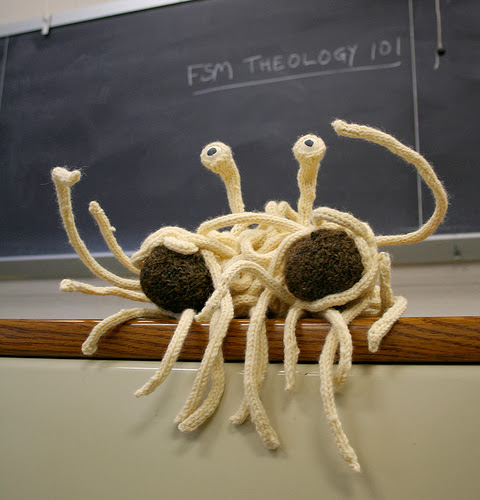
http://en.wikipedia.org/wiki/Flying_Spaghetti_Monster

Pas croyant

Comprenez que je ne suis pas croyant de n’importe quelle religion : je suis fièrement athée et je pense que les croyants perdent leur temps et énergie avec leurs amis imaginaires. Cependant, je suis aussi d’opinion que toutes et tous ont ce droit au gaspillage si elles ou ils veulent, à condition de ne pas exiger que j’adopte leurs croyances. C’est pourquoi je trouve les deux premiers alinéas de l’article 20 tout à fait raisonnables : objectivité dans l’accomplissement de leurs tâches indépendamment de leurs opinions et croyances en matière religieuse et interdiction de prosélytisme. Mais explique moi donc l’exemption de l’application du premier aux médecins et pharmaciens permis par l’article 12 de ne pas recommander ou fournir des services professionnels en raison de leurs convictions personnelles. Ça pue de l’accommodement de professionnels de la santé qui refusent de respecter les gains des femmes québécoises par rapport à leurs choix de planification familiale, non?

Il y a une autre exception à l’article 11 pour les personnes qui offrent l’animation spirituelle dans des établissements de santé ou de détention ainsi que celles qui dispensent de l’éducation religieuse au niveau universitaire ou qui offrent l’animation spirituelle dans un cégep. Ces personnes sont exemptées non seulement du devoir de neutralité, mais aussi de la restriction quant au port d’un signe religieux. Pouvez-vous m’expliquer pourquoi les contribuables, via l’État, paient cette chose qui contredit, selon ce projet de loi, nos valeurs de séparation de l’État et la religion et la neutralité religieuse de l’État? Personnellement, je serais prêt à accommoder un accès à ces personnes aux endroits visés, mais aux frais de leurs organisations religieux.

Où? Sur qui?

Avec ces exemptions, qui demeure couvert (ou bien découvert…humeur mal placé)? Tous les employés de l’État, des organismes publics, des tribunaux, des instances administratives, des commissions d’enquête, l’Assemblée nationale. Et toute une section à part pour les services de garde éducatifs pour les enfants subventionnés par l’État. Pour ces derniers, à part les obligations vestimentaires et de neutralité, il y a l’article 30, alinéa 3, qui ne permet pas de pratique répétée qui tire son origine d’un précepte religieux, notamment en matière alimentaire, si elle a pour but (en mots ou en gestes) d’amener l’enfant à faire l’apprentissage de ce précepte. Plus de biscuits de noël? Ou sont-ils patrimoniaux, alors qu’on ne tolère pas l’apprentissage par rapport aux pâques juives? Je pense sérieusement à déposer une plainte contre chaque décoration de noël que je vais voir dans les bureaux gouvernementaux et certainement sur chaque crucifix que je vois dans de tels endroits.

L’article 10 pourrait étendre l’application de ces règles beaucoup plus loin, dépendant de l’interprétation qu’on va l’accorder. Là on parle de permettre aux organismes publics d’exiger le respect des règles énoncées dans le projet de loi par toute personne ou société il conclut un contrat de service ou une entente de subvention. Je me permets de penser que les qualificatifs de cet article — durée, nature ou lieu d’exécution — vont restreindre un peu son étendu, mais on va voir. Il faudrait préciser plus, je pense.

Les obligations des individus

Les articles 3 à 6 du projet de loi contiennent l’essentiel des obligations des individus : neutralité religieuse (sauf les médecins et pharmaciens, j’imagine), réserve en ce qui trait à l’expression de ses croyances religieuses, interdiction de porter un objet, tel un couvre-chef, un vêtement, un bijoux ou une autre parure marquant ostensiblement par son caractère démonstratif une appartenance religieuse et enfin, l’obligation de travailler à visage découvert, sauf si les conditions de travail ou les exigences de la fonction obligent de couvrir le visage. Ces articles sont réputés inclus dans tous les contrats de travail et des clauses contradictoires sont sans effet. Les demandes d’accommodement sont assujetties à des règles et restrictions et ne peuvent jamais porter sur ce que je vais appeler la tenue vestimentaire.

Les ministères et organismes visés auront une année pour produire une politique de mise en œuvre des dispositions, y compris les procédures pour traiter les demandes d’accommodement. Ce délai peut être repoussé pour quatre ans de plus sur résolution de l’entité concerné et encore plus loin sur approbation du ministre responsable.


Arrivons donc à l’aspect le plus discuté, sur le port de signes démontrant une appartenance religieuse. On dit que ceci n’est pas discriminatoire parce que les chrétiens aussi vont être obligés de ne pas porter d’énormes crucifix autour de leur cou. Rien de plus ridicule sauf, peut-être cette citation que j’ai trouvée concernant l’adoption d’une loi pour empêcher aux personnes de dormir sous les ponts d’une ville européenne : ce n’était pas discriminatoire envers les pauvres, parce que la loi interdisait aussi aux riches d’y coucher. Ce serait faux de conclure que la tenue vestimentaire de toute religion se ressemble et qu’une règle imposant des restrictions soit d’effet égal pour tout le monde. M’est-il possible de porter un hijab, en tant qu’homme et non-croyant? Pour moi ça n’indiquerait pas une appartenance religieuse, mais un choix de mode.

Ce qu’on fait, pas ce qu’on est

Je préfère la règle de juger les personnes et leur neutralité sur ce qu’elles font et non pas ce qu’elles sont. Après tout, c’est ça qui va démontrer la neutralité de l’État pour moi. Regardons les greffiers de certains états aux États-Unis ou les maires de certaines villes en France qui refusent de marier les couples de même sexe. Ces personnes ne portent pas de signes « ostentatoires » mais elles essaient d’imposer leurs croyances sur les autres. Ce qu’ils font et non pas ce qu’ils sont.
J’ai eu l’occasion de confronter mes propres attentes quant aux croyances et au professionnalisme d’une personne travaillant dans un centre hospitalier. Suivi depuis longtemps dans une clinique externe de dermatologie pour détecter et traiter des condylomes, j’ai souvent subi des traitements qui m’ont fait saigner livrés par des hommes hétéros inconfortables avec l’intervention requis. Un jour, la personne qui sortait avec mon dossier dans ses mains et appelant mon nom était une femme en hijab. J’étais certain que cette femme n’allait pas m’aimer et je ne sais pas si elle a formé une opinion sur moi ou sur mon histoire d’homme gai vivant avec le VIH. Ce que je peux témoigner, c’est son niveau de professionnalisme et respect en me traitant. C’est ça qui compte pour moi : ce qu’elle a fait et non pas ce qu’elle est, ni ma projection de mes attentes de ses attitudes basée sur sa tenue vestimentaire. J’ai eu à confronter mes préjugés ce jour-là et je suis assez gêné de les avoir eu et fier de m’en avoir débarrassé.

Parlons de l’insertion de certaines clauses dans la Charte des droits et libertés de la personne, affirmant la primauté de la langue française et de l’égalité entre femmes et hommes. Les documents de protection des droits de la personne existent pour protéger les minorités (et les personnes qui sont souvent traitées comme minorités, alors majoritaires : les femmes) dans une société. Les autres lois, par leur nature, imposent les règles de la majorité sur toute la société et en général, nous n’avons pas besoin de l’intervention judiciaire pour garantir le respect des droits de la majorité. Cette proposition de changement ne devrait pas être recevable.


Un contexte particulier

Le Québec a abandonné l’église lors de la révolution tranquille durant les années 1960, suivant des décennies de répression et de contrôle de l’église sur l’ensemble de la société. On peut dans ces circonstances comprendre un niveau de méfiance envers les vestiges de ce contrôle. De la même manière, nous avons des personnes plus récemment arrivées au Québec qui ont fui des régimes ou des insurgés fondamentalistes et ont vécu au moins le menace sinon l’expérience de répression religieuse. On peut donc comprendre leur méfiance des symboles de contrôle religieux aussi.

Mais ces contextes ne sont pas la réalité du Québec aujourd’hui et ne frappent pas à la porte non plus. L’expérience nous démontre que la participation à notre société a pour impact de changer les attitudes et les choix : les enfants des immigrants d’aujourd’hui vont pour la plupart avoir moins d’enfants que leurs parents, les jeunes font des amis dans leur groupe d’âge de différentes origines et s’intéressent aux mêmes groupes musicaux, etc. Exclure des personnes d’une participation active à la société à travers l’emploi va non seulement ralentir cette intégration, mais érigerait des barrières qui seront difficiles, voire impossibles à traverser.

Ce qui manque dans tout ça est la preuve que ces choses nommées sont vraiment nos valeurs fondamentales. La neutralité religieuse de l’État et l’égalité entre les femmes et les hommes sont parmi les valeurs de notre société et elles sont aussi loin d’être réalisées. Qu’est-ce qu’on fait pour encourager nos concitoyennes et concitoyens à les adopter et les avancer? Au lieu de punir et exclure, pouvons-nous miser sur la promotion de nos valeurs communes?

Oui, à la fin de cet exercice j’arrive à la même conclusion qu’avant. Je trouve les moyens et les objectifs de ce projet décevants. Il n’est pas trop tard de reprendre le projet autrement, de définir les multiples valeurs qui font en sorte que ceci est une société dans laquelle les gens viennent de loin pour vivre, et de trouver les moyens de promouvoir ces valeurs plutôt que de punir et exclure selon nos propres perceptions des attitudes de l’autre.

*****

L’Office national du film du Canada a créé un projet très intéressant en lien avec « la Charte » et je vous encourage de le visiter et l’essayer ici.

16 November 2013

They Can’t Kill Themselves

The Allen Ginsberg character, as a freshman at Columbia, is so disdainful of structured, metred poetry, how could I resist the temptation to review this film in the form of a sonnet?

Columbia seems far too staid a place
To spawn a revolution in the word
But from the moment LuLu showed his face
The rumblings of a radical were heard

We see the user muse in action fast
A party, uninvited guests and all
His current benefactor prey, his last?
Another germinating in the hall

With Bill the young, who sounds like Bill the old
And Jack, the dashing ne’er-do-well, but bright
The drugs, the antics, plots and schemes unfold
The prey drowns softly, helplessly this night

The user muse a loser muse, not nice
He even fails to kill himself, and twice


But still, I am moved by an uncanny depiction of William S. Burroughs as a much younger man than I am used to, with the voice and cadence I have heard recorded for myself, and a scene that makes his literary approach more concrete for the viewers. I have to re-take that sonnet in Burroughs’ cut-up style.

Columbia seems far too staid a radical were heard

We see the moment LuLu showed his last?
Another germinating in action fast
A party, uninvited guests and all
His current benefactor prey, his face
The rumblings of a loser muse, not nice
He even fails to kill himself, and schemes unfold
The prey drowns softly, helplessly this night

The user muse a loser muse, not nice
He even fails to kill himself, and schemes unfold
The prey drowns softly, helplessly this night

The user muse a revolution in action fast
A party, uninvited guests and twice


I used the cut-up engine found here for this exercise. Well, it seems that Blogger didn't like my link (page required java and came with all kinds of warnings. I recommend following the link from my other William S. Burroughs themed post to find a wealth of different resources for text manipulation.

10 November 2013

Falstaff: The Keystone…Merry Wives of Windsor

I have to confess that I was a little worried about how I would feel about this opera after the first scene of the first act. The music was not all that catchy or pleasant, the set not particularly exciting, the character certainly not at all sympathetic. By the end, however, I had listened to treats for the ears, laughed out loud much more than once, and even gasped at the beauty of some of the later sets. I strode into the fresh clean fall air a satisfied opera-goer once again.
I love telling the stories of the operas I see, and this one is no exception. The pompous Falstaff, a knight of apparently insufficient means, plots how to lay his hands on more resources, and possibly some pleasant female company along the way. He is full of his own importance and supremely confident in his allure — much more confident than anyone else is with the same subject. He sets his eyes on not one, but two married women of means as his tickets to providing himself with ample resources for his debauched life. He pens two letters professing his affection, one to each of the two women with very little creativity, substituting names, but repeating the rest of the content. The friends who ride his coattails refuse to serve as messengers and the letters are sent by page.

The two women are good friends, and it doesn’t take long for them to compare letters, mock their would-be suitor, and cook up a ruse to embarrass him in his clumsy self-assurance. Mrs. Ford arranges for another friend, Mrs. Quickly, to carry to Falstaff the news that she is indeed interested, and that her husband is predictable absent daily between 2 and 3 o’clock. Falstaff sets about preparing himself to go courting the married Mrs. Ford.

Meanwhile, Mr. Ford has also got wind of Falstaff’s intentions and is determined to catch Falstaff (and his wife!) in their tryst. He arranges to have himself introduced to Falstaff under an assumed name and takes with him a gift of wine, which the intemperate Falstaff accepts with pleasure. He goes on to brag to his new benefactor of his upcoming conquest of Mrs. Ford, much to the well-disguised chagrin of her husband.

There’s a little side plot going on by this point, too. The Fords’ daughter Nannetta has been promised in marriage to the elderly (and wealthy) Dr. Cajus, but she is in love with the young and handsome (and presumably much less wealthy) Fenton. Her father sternly warns her against seeing Fenton, but her mother seems to tolerate her liaison quite well.

We are now inside the Ford home. The ladies’ plot is about to come to fruition and all is arranged. Falstaff arrives to woo Mrs. Ford, who resists coquettishly, and then suddenly her friend Meg (object #2 of Falstaff’s ill-intentioned affection) appears. This is the ladies’ plan: embarrass Falstaff by revealing their reciprocal knowledge of his multiple advances. No time to dwell on that, however, as Mr. Ford returns home unexpectedly with a whole posse of men, determined to catch his wife and Falstaff in what he thinks is a real affair. Falstaff at first hides behind a screen, then in the clothes hamper. Nannetta and Fenton take up residence behind the screen, where their audible kissing draws the attention of Ford and his men, who think it is Falstaff and Mrs. Ford. The reveal is not necessarily more pleasant for Mr. Ford, who again threatens his daughter to avoid the company of Fenton, as she is promised to the doctor. As they search more rooms in the Ford home, the ladies summon servants to empty the contents of the laundry hamper out the window into the river below.

We cut to a bitter Falstaff trying to dry himself off, and Mrs. Quickly arrives to reassure him of Mrs. Ford’s affection and to arrange a midnight tryst in the park, near a tree named for the Black Huntsman. After much convincing, Falstaff agrees to go, dressed as the huntsman.

More preparations are underway on the other side of this latest ruse, however, with the preparation of costumes to make some of the party look like various spirits and fairies to give Falstaff a good fright. But wait! Yet more deceit, as Mr. Ford, determined to put an end to Nannetta’s wanderings, plans to marry her to the doctor while they are in costume in the park at midnight. Mrs. Ford, however, hatches her own plot with her friends to allow her daughter to marry young Fenton, arranging for him to wear the same monk costume that the doctor will be wearing, and arranging a surprising decoy to be dressed as yet another fairy queen (the costume of her daughter).

Mrs. Ford meets Falstaff, but quickly runs off when she hears the sounds of the approaching “fairies”. Falstaff hunkers down under the tree, determined to avoid looking the fairies in the eye. His silly fear is revealed, as are his impure intentions, and Falstaff manages to fabricate a claim to fame in all of this as, in his words, the rest of them would not seem half as clever were he not on the scene. Hmmm. He might want to rethink that line of reasoning.

Ford sets about carrying out his own plan. He starts to marry the doctor and the fairy queen, when another couple emerges in costume, also wishing to be married. Mr. Ford obliges, only to discover that he has married his daughter to Fenton and the doctor to…Bardolfo, one of Falstaff’s [male] servants! [#TeamBardolfo I was compelled to tweet at this point, or as close to this point as good manners would allow.] Falstaff is happy to step back in, proclaiming that everything in the world is but a jest.

Jean-Michel Richer plays Bardolfo. Where is my doctor disguise?

Well, I do go on about the twisting and turning plot, don’t I?! Shall I get to what ought to be the substance of a review? There was some excellent singing on stage, and more than a little bit of well-acted slapstick humour as well. I thought it got off to a slow start, as I didn’t really enjoy the songs of the first scene, and the slapstick was kind of understated, which is surely contraindicated. There is not much the company could do about the music — that’s Verdi’s fault — and I’m happy to be able to say that it got better, and quickly (yes, a reference to the character, too). The women and the men developing their respective plots to expose Falstaff gave us some lovely and upbeat tunes and chorus singing, which I always enjoy. Then when Mrs. Quickly went to Falstaff’s apartment to communicate Mrs. Ford’s "interest” in him, the slapstick qualities truly emerged with great aplomb. The husband’s posse’s search of the house looked like a scene directly out of the Keystone Cops, as they rushed from room to room, barely missing the object of their pursuit. The music and the singing from then on was quite interesting and enjoyable.

A special note for the sets. I often gauge my appreciation of the sets by the level of my desire to live within them. Not so much this time. The scenes in Falstaff’s apartment were kind of disappointing, and these elements were rearranged and added to for the interior of the Ford home. The addition of a staircase and a couple of pieces of furniture did improve it a bit. At the beginning of Act III — Falstaff’s drying off after his river adventure — I was blown away by a very simple, but beautiful and effective set. A series of wooden fences that offered places to hide behind and/or peek over, with a richly lit background. Very lovely. And then when Scene II of Act III began, I think I actually gasped aloud at the beauty of the solitary and majestic oak tree, again with only a richly lit screen in the back: perfect for the scene in the park at midnight.

It must be a testament to the production that a two-and-a-half hour opera with a single intermission (plus a couple of short pauses) at the end of a long day left me feeling invigorated, not tired, and my friend and I strode happily into the night to get to our respective homes. It’s a win, for sure, and on the level of the plot, I am always glad to see pompous fools called to account for their behaviour.

05 November 2013

Cinema Cinquains, Four


I have again fallen behind in my movie reviews! This time, I catch up with a different form of structured verse, the cinquain. Five lines of two, four, six, eight and two syllables, respectively. I remember writing one of these in my grade twelve English class...a few years ago, that must have been.

Up there
Constellation
is a shiny city
that the filthy dare not dream of.
Unlock!


I can’t
decide which sad
life I disliked the most.
No wasted compassion means no
tear drops.

Happy
little girls get
victimized. Which will win,
homespun “justice” or the real law?
*Whistles*

A time,
desperate time,
where initiative will
get you further than the science.
Just live!

26 October 2013

PR12E14 Charmeuse and Coffee

I am more than a little behind on watching and reviewing this one, but I have a lovely excuse, as I was in Paris last week for meetings. The two big TV events there were news stories — a controversy over a young Roma girls removed and deported with her family while she was on a school trip and a bitter primary battle in the Parti socialiste for the party candidacy in the race to be mayor of Marseilles. Enough of that and art and stuff, and back to what really matters: American wannabe designers in reality TV!

We start with a flashback of Helen being eliminated and then a lovely little “gather ‘round” moment with Tim underlining the specialness of the occasion. They will be off for one last visit to Mood — budget of $250 — because of the classy “Tide Pod” Challenge, creating a washable look that will bump one of their other looks from the runway. This pushes them to head off in search of such sought-after fabrics as “blends” and “poly blends”. A shudder makes its way up my spine.

Upon return to the workroom, they have a quick detour through the hair department, especially since Justin got severely criticized for his models’ hair last week and Alexandria seemed convinced that her braid look didn’t turn the judges’ cranks either (although I don’t recall that). I saw some extreme volume in the making!

Tim visits and has some general chatting with the contestants. He calls Bradon’s collection “sexy”, but I will have to go with Dom’s judgement on this one. She is curious to see what the judges will make of it, because she thinks it just looks old. I see so few pieces that I actually find pleasing that I would probably have as much trouble as Bradon in choosing which look to toss to make room for the “washable” one, but I suspect our hesitations are not coming from the same place.

For Dom, Tim reminds that the scale of the prints she is using means that it is very important for her to be symmetrical. The he turns and points to one dress and says how nice it looks in the middle, but that it gets “all janky” on the sides. Let me just say that I don’t get the big graphic print thing, especially if it is organized symmetrically, which is reason number 453 that I am not a teacher/mentor at design school, I guess. I am also not fond of Bradon’s interpretation of spring in old-lady florals, but I don’t think that disqualifies me from the aforementioned career in the wearable arts.

I’ll have to go with Alexandria’s comment about Justin’s collection. She says he has elements that are very innovative, but wonders if it is the garments or only the 3-D printed jewellery. I have to say those plastic pieces looked very interesting at the outset, especially with the “sound wave” back story, but they are losing their novelty in their ubiquity. Still loving the sound wave patterns on some of the outfits and, oddly enough for me, the paint-splattered pieces as well. So I’m not totally anti-print in the end.

Alexandria is a bundle of nerves and self-doubt at this point. She frets that Nina will see most of her tops as “another dumb t-shirt”. Tim helpfully reminds that the judges love to be listened to, so little tweaks and nods are necessary, or retribution will follow. Alexandria decides to replace some of her t-shirts with “slightly more special” tops. She has obviously forgotten about the time. Dom thinks Alexandria is “crazy” for undertaking that task.

I think we have seen more this year than any other of designers micro-managing their models. Choosing just the right piece for the right model, being very specific about how she should walk…I’m sure these things always happen (I would be disdainful if the designers didn’t have strong opinions about those things as parts of their looks), but we have seen more of it this time around. I think that was a compliment.

I don’t have much to say about the Billy B makeup consultation — oh, wait, I do have a couple of observations. I was waiting to see if Billy B would be there for the consultation with Justin, since I noticed that we didn’t see the two of them talking in the butterflies episode. I decided at that point that BB might be deaf-phobic, but he was front and centre for this final episode. Also front and centre was a life lesson for the rest of us from Billy B: if you absolutely must get a neck tattoo, or a tattoo that reaches up past your collar, do stay out of the sun. There’s something about overtanned old tattooed neck skin that just doesn’t scream “beauty” for me. Am I out of design school again?

Tick, tick, tick…the clock is running and we are getting to the end of the work room time on the day before the runway show. Bradon starts looking like a turkey at Thanksgiving, running back and forth because he doesn’t want to lose the time it would take to just walk. Dom finds the frantic running around irritating and we can see that it is also upsetting Justin, who may have turned off his hearing device, but can’t turn off his eyes. Then Tim comes in for a last “gather ‘round” moment and all Bradon can think to say in the side comment is about how wasteful that is of the time they have left — I think he was hoping to get in a good 10K run between his work station and the sewing room in that time. “How great is this?!” from Tim reduces them all to tears — happy, tired tears — which is most helpful for their productivity in the hour that remains.

Frantic gives way to peaceful overnight at the hotel. A little like Christmas, I might say, as the excited contestants get up early and have some reflection time before walking through the dark and quiet streets of Manhattan over to the Lincoln Centre for the show. One of them will surely get the present that s/he wants, waiting under the Lincoln Centre or Parson’s tree…

Peaceful can’t last, though. Frantic prepping underway, Tim arrives to give Justin some bad news: one of his models had broken her ankle and will have to be replaced. This with no real time to alter the garment she was supposed to wear. To those of us not “in the know” those models all look to be about the same size and shape (tiny and rail thin), but apparently they have different body types, at least in the eyes of those who are more tuned to such things. Justin’s not the only one with a setback that morning, as Bradon frets about how close the models’ food and coffee is to his clothes, right up until the moment where one of the models spills coffee down the front of the blue charmeuse gown. [Note to anyone wondering what charmeuse is about: it looks like a French word meaning charmer, but it is apparently a fabric treatment that you can do in silk (good) or polyester (what now?) and is to be pronounced “shar-moose”, at least in ‘Murrica.] Bradon frantically tries to figure out how to get the coffee stain out, apparently not even considering the Tide Pod sponsor….just saying.

The runway shows! Scan the audience first, though, and you will see a ton of friends and family members and then contestants from previous seasons, along with some from the current season (the eliminees, of course). I did not see either Sandro or Ken, so I will have to conclude that there were security guards at the door to keep them out. No models tripped and, to tell you the truth, I didn’t even see any coffee stains on Bradon’s gown, probably because I had to turn my head away from the icky floral print.

The judging started off well, with inspiring words from Heidi about how impressed they were and what a difficult task it would be to choose a winner. There were a couple of hints from Nina about who would likely not win — she wanted to see a couple more pieces from Justin that would bring a “wow” factor and she thought that Bradon’s collection was “disjointed”. We were also treated to Alexandria’s assertion that we need to stop printing phone books (I’m more on board with the statement than with the dress she made with the discarded offending items).

Then an invitation to share with the judges why each of them thought they should win. It was a tear-fest and a contest to see who had more challenges in their lives that was kind of difficult to watch:

Justin: he has been walked over all of his life because of his deafness, also hadn’t won a single challenge all season, so would like to start with this one.

Dom: she knows this is what she needs to be doing for the rest of her life and would be able to take the victory and turn it into something that matters.

Bradon: he had a 30 year career in dance that is over, thought he had nothing else until he found fashion and has come to this level of success after only 3 years.

Alexandria: she’s bankable and knows what girls want to wear, has sacrificed a lot, building two businesses from nothing, and is not there to come second. (Dangerous prediction, that!)

Designers go away for the judges’ close-up with the model muses. Here Zac really stands out for the inane comments:
  • Bradon needs more experience (D’oh! He shouldn’t have pointed out that this was only year 3 of his designer career!)
  • Dom doesn’t even know how sophisticated she is.
  • Alexandria thinks she’s so good on the construction Z wants to see the details to pick holes in it (but can’t, as it actually is good).


They’re back for the verdict. Bradon is out, and we are not really surprised at this point. Justin is out, which kind of caught me off guard. Then we are, in Heidi’s words, “down to the two girls”. (At this point I’m remembering Alexandria’s assertion that she wasn’t there to come in second with no small amount of foreboding.) And….Dom is the winner, but all the women on the judging panel will be calling Alexandria because they want her clothes.

I appreciated Alexandria’s honesty and sincerity after the verdict. “I feel let down.” “I’m happy she won, she’s a good person. I mean that.” That was very kind of her, in her disappointment and exhaustion.

For her part, Dom had a little honesty and optimism. She’s poor, she has been working two jobs, feels like she is always working and never has time for her craft. The win, for her, changes everything. We’ll see if it gives her a better boost as a designer than it has for most of the other Project Runway winners. I’ll be hoping that what it changes is her taste in prints.

25 October 2013

Spill it, milk company!

Unsatisfying doesn’t quite cover it. Annoying either. I would have to say that the recall of certain milk products that I heard about this morning on my radio, then on the television, then on the internet, left me feeling frustrated.

What I found in the company’s press release (by the way NOT published on their web site!) was a vague and unsatisfying direction to not consume certain products (best before dates and other identifiers included), but not explaining why. I wasn’t just driven by curiosity in all of this. No, I had just finished my breakfast with a lovely cold glass of milk and was starting to drink my morning coffee, again with milk. A quick check of the best before date and the other code confirmed that this was indeed the milk being recalled.

The problem for me is not just that I had already consumed two of the three bags of milk in the 4-litre milk pack that I had bought last week. The bigger problem is that my immune system is rather fragile and I haven’t received any indication of what might have been the problem. Should I be proactively seeking some kind of treatment to avoid bad effects of this product which “did not meet your quality standards” (from the press release). Come clean and tell us what the problem was and you will help me rebuild my trust of your product.

Oh, and your direction for me to return it to my store for a refund? Useless. I’m not willing to dig through my recycling bin to try to retrieve what might have been the receipt for it and then cart it all the way back to the store, hoping that they will refund me for an incomplete return. No, I snapped the picture above and then I dumped it. I hope the thing you are keeping from us is not something that will damage the environment as it works its way through the city’s treatment facilities.